Online Keywords Review 2020 Pandemic: "Mainland" Emerges as the Hottest Term of the Year

Online Keywords Review 2020 Pandemic: "Mainland" Emerges as the Hottest Term of the Year

2020-12-23Buzz
This year, the novel coronavirus wreaked havoc globally, and Hong Kongers united to combat the pandemic. uMax Data analyzed big data from the internet, using trending keywords to review the fluctuations of the pandemic in 2020. We found that during the initial outbreak, people were filled with fear and anxiety, with pandemic prevention supplies like masks and hand sanitizers becoming the focus of online discussions. By the second half of the year, the focus shifted to government anti-pandemic measures, economic issues, and policies derived from the pandemic. The most trending keyword throughout the year was "mainland." Online engagement with pandemic-related topics began to decline noticeably as early as February, reflecting that Hong Kongers may have experienced pandemic fatigue.

✦ Top three keywords of the year: mainland, mask, medical bills✦

uMax Data Technology Co., Ltd. (uMax Data)For Facebook posts published by major media outlets in 2020, an AI system and over a decade of Chinese word segmentation technology were employed to identify the most frequently used terms. These terms were then analyzed to calculate their social media interaction index (engagement score), which was visualized in a word cloud. In the word cloud, the larger the font size of a keyword, the higher the level of online user interaction and response it reflects. Looking back at 2020, the terms "mainland," "face masks," and "medical staff" gained significantly more attention than other phrases, reflecting the three most critical aspects of the pandemic for Hong Kong media and netizens this year. (See Figure 1)
  • Top Buzzword of the Year - 「Mainland China」
Netizens have been concerned about the pandemic situation in mainland China since the beginning of the year. Initially, there were worries about the virus spreading from the mainland to Hong Kong. Mid-year, the dispatch of mainland personnel to support Hong Kong's universal testing plan also sparked discussions. By the end of the year, society remained highly focused on reopening travel with the mainland and vaccines developed there, making "mainland China" a consistently trending keyword throughout the year.
  • Runner-up for the Annual Hot Word - "Face Mask"
Face masks garnered significant attention in the first half of the year, frequently ranking as the top keyword for multiple months and rightfully securing a spot among the top three. As a fundamental defense against viruses, their prominence began with shortages early in the year. Later, as local production ramped up and the government introduced the "CuMask+," the supply stabilized, leading to a gradual decline in public interest.
  • Third Place in the Annual Hot Keywords - "Medical Staff"
At the forefront of the fight against the pandemic, healthcare workers sparked public debate over border closures during the strikes earlier this year. Meanwhile, extensive media coverage of frontline medical stories deepened public understanding of the work done by those in the "Dirty Team," making "healthcare workers" the third most popular term of the year. (Figure 1: Annual Facebook Word Cloud of Pandemic-Related Hot Keywords)  

✦ Discussion Heat Slides Down as Netizens Experience Pandemic Fatigue✦


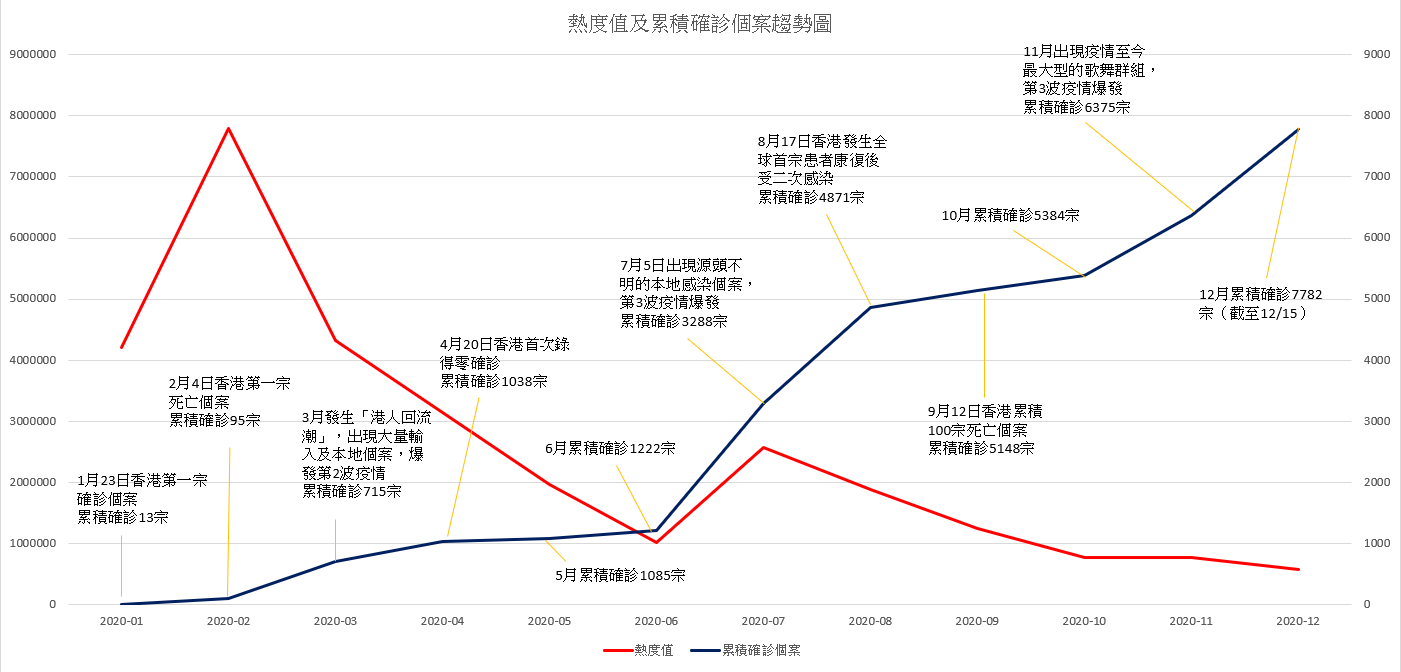
Looking at the trend of engagement metrics for pandemic-related posts by media outlets on Facebook in 2020, discussions surged from January 23 when Hong Kong recorded its first confirmed case, peaking in February due to events such as healthcare workers' strikes demanding border closures and citywide mask shortages. Subsequently, engagement levels saw a sharp and sustained decline. Even during the second wave of infections in March, engagement remained significantly lower than in February, continuing to drop until July—when the third and most severe wave of outbreaks led to a slight rebound. However, overall engagement still fell short of early-year levels, before declining again toward the year's end.   Media coverage of the pandemic has failed to generate as widespread a response as it did earlier in the year. Even with the sharp rise in confirmed cases in the latter half of the year, it could not prevent the overall decline in public interest, which may serve as evidence of pandemic fatigue among Hong Kong residents. (Figure 2: 2020 Facebook discussion heat index and cumulative confirmed case trend chart related to the pandemic)        

✦ Monthly Focus Keywords✦

By observing the monthly key focus words, one can trace the ebb and flow of the overall pandemic situation: "masks" dominated the first half of the year, while the latter half shifted focus to epidemic prevention measures and relief policies. With the recent surge of the fourth wave and the emergence of vaccine development breakthroughs, a clear transition in priorities becomes evident.
monthfocus keywordmonthfocus keyword
JanuaryMainland, epidemic, masksJunerestaurants, outbreaks, infections
Februarymedical staff, masks, mainland ChinaAugustUniversal testing program, mainland China
MarchMasks, isolation, hospitalsSeptembercommunity, mainland,relaxation
Aprilmasks, medical staff, Legislative CouncilOctoberEmployee, Lam Cheng, activity
MayMasks, Lam Cheng, epidemic preventionNovemberFourth wave, infection, virus
Junemasks, infection, BeijingDecemberfourth wave, vaccines, outbreak
  • January: The mainland is experiencing a severe outbreak. Hong Kong people have a strong awareness of wearing masks.
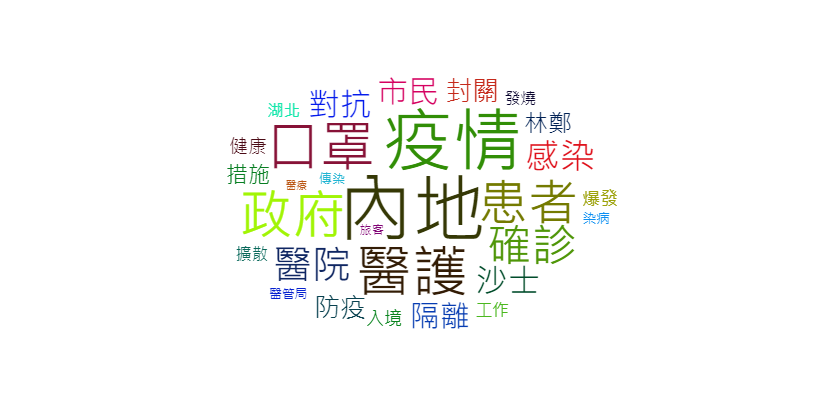
In early January, Hong Kong had not yet recorded any confirmed cases, and online attention was focused on the development of the epidemic on the mainland, making "mainland" and "epidemic" the top trending terms of the month. Many people compared this outbreak to the 2003 SARS epidemic that had ravaged Hong Kong. Having developed a strong awareness of epidemic prevention from that experience, Hong Kong residents began wearing masks early on, propelling "mask" into the list of trending terms as well. (See Figure 3) (Figure 3: January Facebook keyword cloud visualization of pandemic-related focal topics)  
  • February: Citywide mask shortage Healthcare workers' strike sparks border closure controversy
From February 3 to 7, healthcare workers initiated a strike demanding the government to close borders, propelling terms such as "border closure," "strike," and "Hospital Authority" into trending keywords. Discussions targeting "healthcare workers" also saw a higher proportion compared to the previous month. Meanwhile, the shortage of masks plunged the entire city into a frenzy of panic-buying. Not only did ordinary citizens scramble for masks, but frontline medical staff also faced shortages of protective gear. Netizens actively shared information on mask sales, further elevating the popularity of "masks" closely following that of "healthcare workers." (See Figure 4) (Figure 4: February Facebook keyword cloud map related to the pandemic)  
  • March: Hong Kong residents stranded abroad return to Hong Kong Isolation becomes the focus
On March 4, the government arranged the first chartered flight to Hubei to bring back stranded Hong Kong residents and accommodated them in Chun Yeung Estate, significantly increasing the public focus on "quarantine." Netizens were equally concerned about the pandemic situation overseas, worrying about the potential importation of the virus. Terms such as "Europe" and "entry" also became hot keywords. (See Figure 5) (Figure 5: March Facebook Epidemic-Related Keyword Cloud Visualization)  
  • April: Locally Made Masks Roll Out  Second Round of Anti-epidemic Fundlaunch
In April, local mask production lines gradually became available for sale, with "mask" remaining the hottest keyword. Meanwhile, the government rolled out the second round of the "Anti-epidemic Fund," which included relief measures such as the Employment Support Scheme, Legal Tech Fund, and Distance Business Programme. These proposals were submitted to the Legislative Council for deliberation, making related terms like "Legislative Council" and "meeting" among the top trending keywords. (See Figure 6) (Figure 6: April Facebook pandemic-related keyword cloud visualization)
 
  • May: Government distributes copper-infused masks  Citizens concerned about relaxation measures
In May, the government announced the free distribution of reusable masks to every citizen, propelling the "Innovation and Technology Bureau"—a key department—to appear on the word cloud for the first time. This also contributed to "mask" reclaiming its position as the top trending term, while driving related words like "registration" and "reusable" into the spotlight. Notably, the easing of the pandemic that month also drew attention, with a series of relaxed prevention measures, such as "resumption of classes," "easing," and "relaxation," making their way onto the word cloud. (See Figure 7) (Figure 7: May Facebook Pandemic-Related Focus Keyword Word Cloud)
 
  • June:Various epidemic prevention restrictions have been relaxed. Beijing's COVID-19 situation draws attention
In June, the local epidemic situation continued to ease, with no local confirmed cases for 17 consecutive days, shifting public attention to the second wave of the outbreak in "Beijing." Due to the relatively low number of local cases that month, the diagnosis of a couple living in Lek Yuen Estate pushed "Sha Tin" into the spotlight as a trending keyword. (See Figure 8) (Figure 8: July Facebook Pandemic-Related Keyword Cloud Visualization)  
  • July:Third wave outbreak sparks backlash over dine-in ban at restaurants
The July spotlight keywords primarily revolved around the third wave of the COVID-19 outbreak. Among them, the full-day ban on dine-in services at restaurants sparked public dissatisfaction, making "restaurants" the top keyword of July. Other terms related to the third wave outbreak, such as "outbreak" and "third wave," also became key focus words for the same reason. Additionally, the postponement of the "Legislative Council" election and the "book fair" made their way into the word cloud. (See Figure 9)   (Figure 9: July Facebook pandemic-related keyword cloud visualization)  
  • August:Universal Testing ProgramThe government announced that classeswill resume on September 23.
In August, the government launched a universal testing program, sparking online discussions about the organizations involved in the testing and whether the testing should be conducted. This made the "Universal Testing Program" the undisputed top buzzword of the month, while related terms such as "mainland" and "support" also made the list. (See Figure 10)
(Figure 10: August Facebook Epidemic-Related Focus Keyword Word Cloud)  
  • September:The epidemic has subsided.Citizens urge relaxation of measures
In September, the pandemic situation saw another decline, sparking increased discussions about "easing" epidemic prevention measures. However, the severity of the previous third wave left netizens concerned about potential hidden transmission chains within the community. Some also debated the effectiveness of the government's earlier community testing program, making "community" and "mainland China" the key terms for the month. (See Figure 11) (Figure 11: September Facebook keyword cloud map related to pandemic focus topics)  
  • October:Cathay Pacific announces large-scale layoffs Bar currently infected cluster
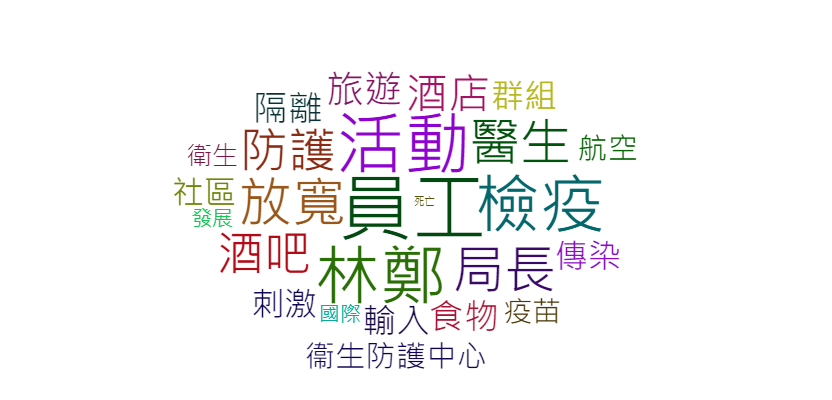
In October, Financial Secretary Paul Chan Mo-po announced that the third round of the Employment Support Scheme would not be implemented. In the same month, Cathay Pacific's announcement of large-scale layoffs made "employees" and "aviation" key topics of online discussion. Additionally, a "bar" became the site of a transmission cluster, which was the largest group recorded at the time. Due to the dismal state of the tourism industry, many "hotels" introduced Staycation promotions to attract local residents. (See Figure 12) (Figure 12: October Facebook pandemic-related keyword cloud visualization)
 
  • November:Singing and dancing cluster triggers fourth wave outbreak
The "dance and singing cluster," which has recorded the highest number of confirmed cases since the pandemic began, triggered the fourth wave of infections, making the keyword "dance and singing cluster" a focus of netizens' attention. As the outbreak unfolded, news related to infection cases once again drew widespread concern from netizens, with terms such as "infection," "fourth wave," and "source" becoming key focal keywords in November. (See Figure 13) (Figure 13: November Facebook Epidemic-Related Hot Word Cloud)  
  • December: Vaccines Expected to Arrive in Hong Kong Next Year – A Special Christmas Amid the Pandemic
The top buzzword in December was "fourth wave," reflecting the ongoing concern over the development of the fourth wave of the pandemic, with civil servants once again working from home after resuming office duties mid-year. Meanwhile, "vaccine" was also a key focus in December, with reports suggesting that vaccines could arrive in Hong Kong as early as January next year. However, their production origins and vaccination arrangements sparked intense online discussions among netizens. (See Figure 14) (Figure 14: December Facebook Word Cloud of Pandemic-Related Hot Keywords)

————————————————————–

We provide precise data, AI Tools and Innovative Solutions!

uMax Data Technology Limited, founded in Hong Kong in 2016, is an innovative technology company driven by artificial intelligence and data. uMax Data offers a variety of SaaS products and solutions, including Social Intelligence Platform (SIP), on-premises AI server, social listening and online alert systems, all-in-one intelligent research and event management platform, AI search engines, social intelligent customer service platforms, AI Agents and chatbots, brand public opinion insights, social media risk management, and multimodal data processing and digital upgrading solutions. These are collectively known as "Social Intelligence." These products not only enhance enterprise productivity and efficiency but also help businesses make more informed decisions.

Want to analyze customer opinions through online discussions? Understand what netizens are thinking? Emailinfo@umaxdata.com immediately to request related case studies and insight reports.

New

Product

Cases

About

News

English繁體中文
Logout